737 Boarding Simulator
Design the optimal boarding algorithm and compete on the global leaderboard
Quick Start
- 1Write your algorithm in the code editor on the left. Your function receives an array of passengers and must return them in boarding order.
- 2Click BEGIN_BOARDING to watch your algorithm in action. Passengers will board the aircraft one at a time, stow their luggage, and take their seats.
- 3Test with BATCH_100X or BATCH_1000X to run your algorithm across many different passenger configurations and see average performance.
- 4Submit to the leaderboard when you're satisfied. Your algorithm will be evaluated across 1,000 randomized scenarios to calculate your official score.
The Objective
Your goal is to minimize the total boarding time measured in ticks. A tick is the simulation's unit of time—each tick, passengers move one step forward in the aisle, make progress stowing luggage, or wait if blocked.
The challenge is that different boarding strategies have different tradeoffs. Boarding window seats first (WILMA method) reduces seat interference, but may cause more aisle congestion. Back-to-front boarding is intuitive but often performs poorly due to clustering. Your job is to find the optimal balance.
The Aircraft
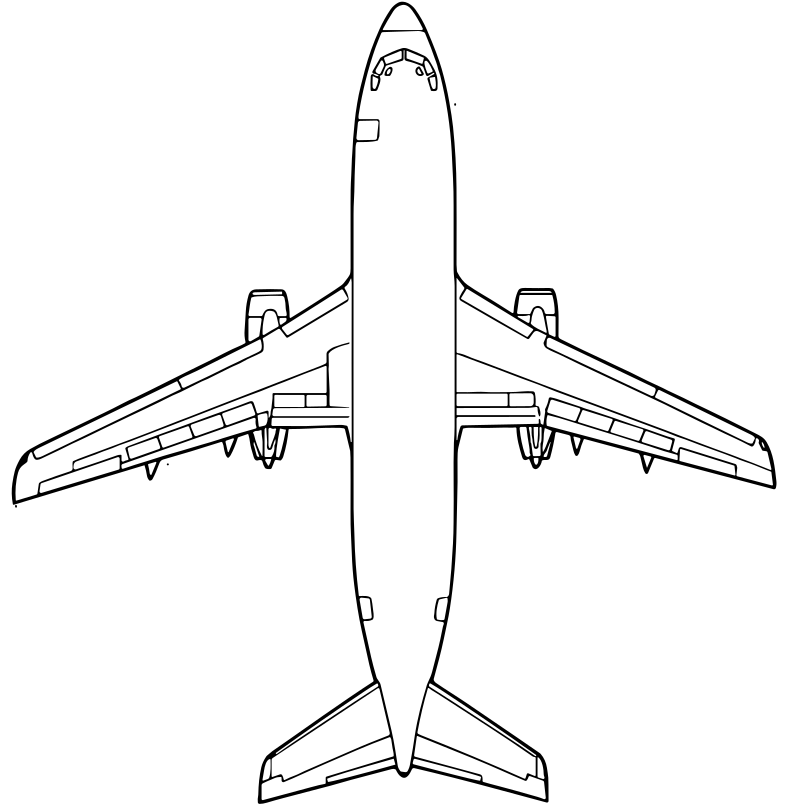
The simulation uses a Boeing 737-800 configuration with 30 rows in a 3-3 layout (seats A-B-C on the left, D-E-F on the right). Total capacity is 178 seats, with approximately 85% filled (~150 passengers per simulation).
- Row 1 — Bulkhead row (extra legroom, no under-seat storage)
- Rows 14-16 — Exit rows (seats 15A and 15F removed for overwing exits)
- Single aisle — Only one passenger can occupy each aisle position at a time
Passenger Types
Each passenger has a type that determines their walking speed and luggage stowing time. These values have some randomization (±20-30%) to reflect real-world variability.
Regular adult travelers. Speed: 1.0x, Stow time: ~3 ticks. The most common passenger type (~55% of solo travelers).
Frequent flyers with minimal, organized luggage. Speed: 1.2x, Stow time: ~2 ticks. They're efficient and quick to settle.
Senior travelers who need more time. Speed: 0.5x, Stow time: ~5 ticks. Often travel in pairs with a caregiver.
Young passengers traveling with family. Speed: 0.8x, Stow time: ~1 tick. Light luggage but slower walking. Usually part of a group.
Passengers requiring mobility assistance. Speed: 0.3x, Stow time: ~8 ticks. The slowest passenger type but only ~5% of passengers.
Light travelers with only a personal item. Speed: 1.0x, Stow time: ~1 tick. Minimal overhead bin usage.
CRITICAL: Travel Groups
Approximately 25% of passengers travel in groups of 2-3 people seated together. These represent real-world scenarios like:
- Couples — Husband and wife seated in 14A and 14B
- Families — Parents with a child in seats 22D, 22E, and 22F
- Elderly + Caregiver — Senior traveler with an assistant in 8B and 8C
Groups MUST board consecutively!
Your algorithm must keep group members together in the boarding order. If a family is separated (e.g., the child boards 50 passengers after the parents), the simulation will flag a GROUP_SEPARATION validation error. While the simulation will still run, separated groups are penalized in leaderboard scoring and represent poor real-world outcomes.
Groups are identified by groupId (null for solo travelers). The isGroupLeader property indicates the primary traveler who should board first. Use groupMemberIds to find related passengers.
Seat Crossover Penalty
When a passenger needs to reach a window or middle seat, they may need to cross over passengers who are already seated. This is expensive!
- +2 ticks per person for the passenger to squeeze past
- +2 ticks standup time for seated passengers to stand in the aisle
- +2 ticks sitdown time for them to return to their seats
- Aisle blocked during the entire crossover process!
This is why WILMA (Window-Middle-Aisle) boarding can be effective—window passengers board first, then middle, then aisle, minimizing crossovers.
Overhead Bin Contention
Each row has overhead bin capacity for 6 pieces of luggage (both sides combined). When a passenger's row is full, they must walk to find available space.
- Passengers check their own row first, then search forward (toward the front), then backward
- +2 ticks per row walked to reach an alternate bin
- +2 ticks per row to walk back to their seat
- This extra time is added to their stowing duration, blocking the aisle longer
Bin conflicts are tracked in the event log as bin_conflict events. Back-to-front boarding tends to cause more bin contention because rear passengers fill up rear bins, forcing later passengers to walk further.
Passenger Properties
Your algorithm receives an array of passenger objects. Here are all the properties you can use to sort them:
Seat Information
row(1-30) — Row numberseat("A"-"F") — Seat letterseatIdx(0-5) — Seat index (A=0, F=5)isWindowSeat(bool) — Seats A and FisMiddleSeat(bool) — Seats B and EisAisleSeat(bool) — Seats C and DisExitRow(bool) — Rows 14-16isBulkhead(bool) — Row 1
Passenger Attributes
type(string) — STD, BUS, ELD, CHD, WCHR, BAGspeed(0.24-1.44) — Walking speed multiplierluggageTime(1-10) — Base ticks to stow luggage
Group Information
groupId(int|null) — Group identifiergroupSize(1-3) — Number in groupisGroupLeader(bool) — Primary travelergroupMemberIds(int[]) — Other member IDs
Built-in Algorithms
Use these as starting points or benchmarks. Select them from the dropdown to see their code:
RANDOM_SHUFFLE
Baseline random ordering. Surprisingly not terrible! Averages ~450-500 ticks.
BACK_TO_FRONT
Traditional airline method. Board row 30 first, then 29, etc. Actually performs poorly (~500+ ticks) due to aisle clustering.
FRONT_TO_BACK
The worst strategy. Front passengers block everyone behind them. Included for comparison.
WILMA_METHOD
Window seats first, then middle, then aisle. Reduces crossover penalties. Typically ~350-400 ticks.
STEFFEN_PERFECT
Theoretically optimal: windows first, alternating rows (30, 28, 26... then 29, 27, 25...). Often ~300-350 ticks.
GROUP_PRESERVE
Back-to-front but keeps groups intact. A good starting point that passes validation.
Leaderboard & Scoring
When you submit to the leaderboard, your algorithm is evaluated server-side across 1,000 different random seeds. This ensures your algorithm is robust across different passenger configurations.
Mean ticks across all 1,000 simulations. Lower is better.
Percentage of simulations without group separation errors. 100% required for ranking.
Maximum ticks in any single simulation. Used as a tiebreaker.
You can submit multiple times and keep improving. Only your best score counts. Use the SAVE button to store your algorithms locally so you can iterate on them.
Tips & Strategies
What Works
- Spread passengers out — Avoid clustering. Passengers stowing at adjacent rows block each other.
- Board window seats first — Reduces crossover penalties significantly.
- Consider bin capacity — If too many passengers board at the same row range, bins fill up.
- Use batch testing — Run BATCH_1000X to find edge cases in your algorithm.
What Doesn't Work
- Strict back-to-front — Creates aisle congestion and bin contention.
- Ignoring groups — Splitting families causes validation errors.
- Front-to-back anything — Early boarders block the entire plane.
- Optimizing for one seed — Your algorithm must work across all configurations.
Built with TanStack Start, Cloudflare Workers, and D1. Algorithm execution is sandboxed and secure.
Inspired by real-world research into airline boarding optimization.